A Local Translator on 0.8B: What People Are Arguing About Around PLaMo 3 Translate
💬 Worth debating
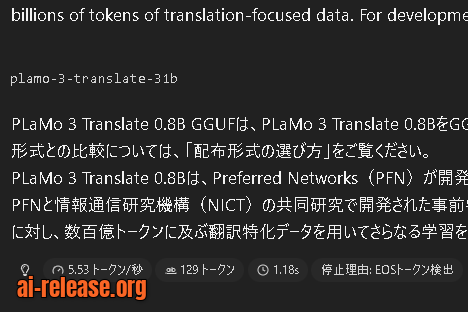
The Japanese tech scene is picking apart an Impress Watch piece from its AI PC series: the author runs PLaMo 3 Translate, a translation model, locally on a device — a specialized model, not a general-purpose one, with 0.8 billion parameters and claimed support for 53 languages. The interesting part isn't the model itself but the bet on specialization: instead of a big chatbot, a compact network built for one task, running on your own hardware.
The argument is over what matters more for translation: scale or focus. Fans of local solutions lean on privacy (your text never leaves for the cloud), no per-token fees, and predictable latency. Skeptics counter that a list of 53 languages doesn't equal 53 high-quality language pairs, and 0.8B leaves almost no headroom for context, terminology, and style.
The third thread is the "AI PC" format itself: pieces like this push the idea that inference is moving onto the user's device. But the writeup includes no comparisons with cloud translators or with larger local models, so for now this is a demonstration of an approach, not a benchmark.
🧠 Our take
- For: specialization. A single task instead of do-everything lets a small model hold up where steady, reliable translation matters more than encyclopedic knowledge.
- For: privacy and offline use. Local inference is handy for documents you can't send to an external service.
- For: cost and latency. No per-token billing, no network round-trip — predictable when embedding into a workflow.
- Against: "53 languages" is a marketing frame. Quality on rare language pairs and narrow terminology usually sags, and the testing methodology isn't disclosed.
- Against: 0.8B limits context and style. For legal, medical, and marketing texts, that headroom may simply not be enough.
⚠️ What we don't know
The writeup doesn't name the developer, the license, the hardware requirements, or any comparison with cloud services. It's also unclear how translation quality across the 53 languages was actually measured.
❓ Your call
1. Would you trade a cloud translator for a local model if quality dropped on your language pair?
2. What matters more for your workflow: keeping text in-house, or preserving quality on rare languages and specialized terminology?
3. What model size and latency threshold would you consider acceptable for a laptop without a discrete GPU?
Source: forest.watch.impress.co.jp
🤖 AI summary
- Date: 2026-11-15
- Source: forest.watch.impress.co.jp
- Tags: азия, обсуждение, локальные llm, перевод, япония, ai pc
- Key facts:
- The Japanese tech scene is picking apart an Impress Watch piece from its AI PC series: the author runs PLaMo 3 Translate, a translation model, locally on a device — a specialized model, not a general-purpose one, with 0.8 billion parameters and claimed support for 53 languages.
- The interesting part isn't the model itself but the bet on specialization: instead of a big chatbot, a compact network built for one task, running on your own hardware.
- The argument is over what matters more for translation: scale or focus.
- Fans of local solutions lean on privacy (your text never leaves for the cloud), no per-token fees, and predictable latency.
- Skeptics counter that a list of 53 languages doesn't equal 53 high-quality language pairs, and 0.8B leaves almost no headroom for context, terminology, and style.
- The third thread is the "AI PC" format itself: pieces like this push the idea that inference is moving onto the user's device.
- But the writeup includes no comparisons with cloud translators or with larger local models, so for now this is a demonstration of an approach, not a benchmark.
- For: specialization.
Source: forest.watch.impress.co.jp · post in Telegram