Identity for AI Agents: What the Japanese AWS Community Is Debating
💬 What's Being Debated
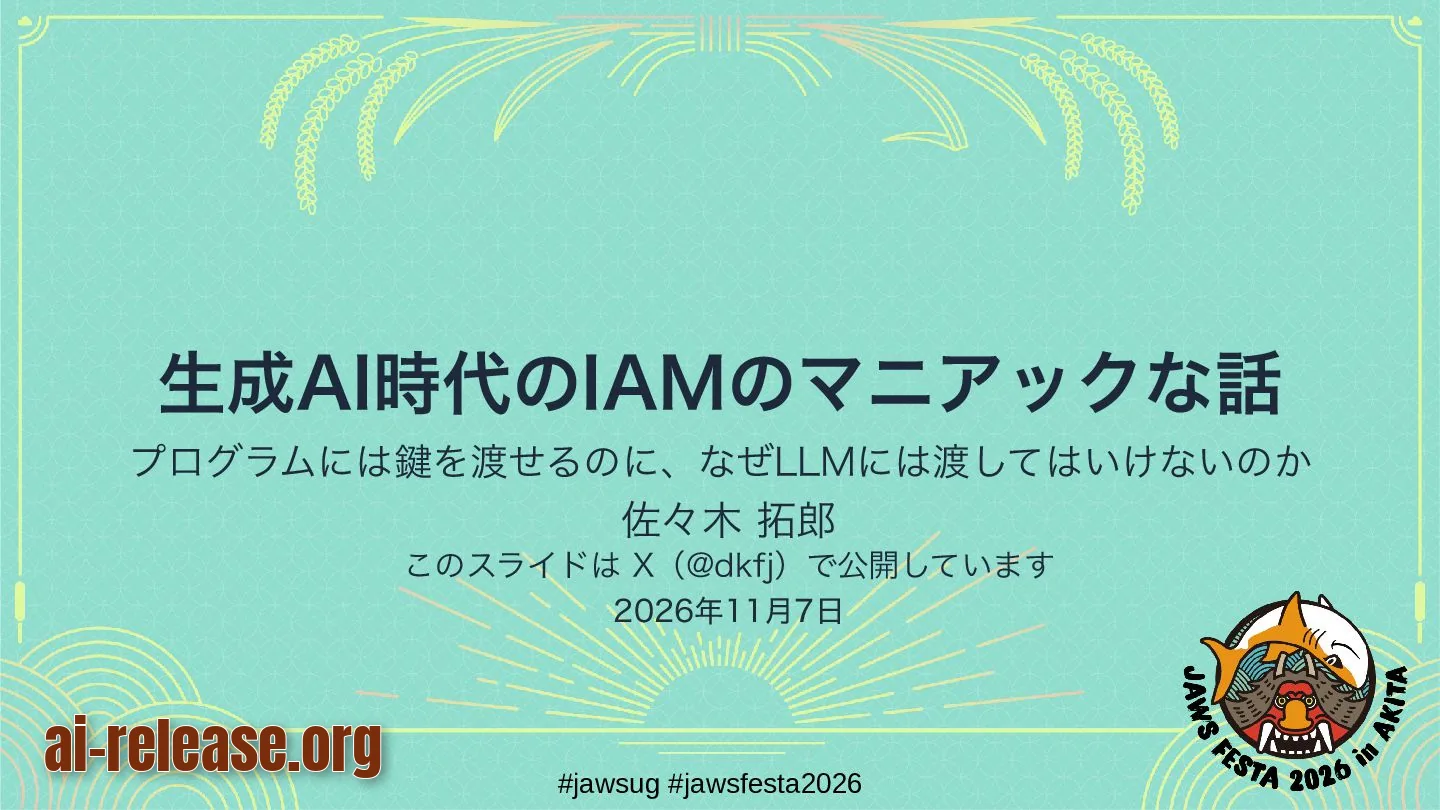
At JAWS Festa 2026, the Japanese AWS community tackled a topic that seemed niche before generative AI: how to structure IAM when the infrastructure includes not only humans and service roles, but also AI agents acting on someone's behalf. The talk materials are posted on Speaker Deck and discussed on Hatena — judging by the title's wording, this is a deliberately detailed, technical deep-dive rather than a trend overview.
The interest lies in the fact that the familiar "human — role — resource" model is faltering: an agent acts autonomously, the decision chain gets longer, and reconstructing after the fact why exactly a given action was taken becomes harder. Hence the core debate: should an AI agent be treated as a separate identity, or is a set of permissions granted to a human enough?
The second layer is scale. If every agent experiment requires its own role, separate policies, and secret rotation, security starts competing with product work for engineers' time.
🧠 Arguments on Both Sides
- For a separate agent identity: it's easier to restrict permissions, revoke access, and attribute audit trails to a specific actor.
- For least privilege and short-lived credentials: this is basic hygiene, but it requires automation, otherwise people work around it manually.
- Against added complexity: the more entities and policies, the stronger the temptation to "just allow it to be safe," and all the gains are eaten away.
- For human confirmation on dangerous actions: it curbs agent errors, but reduces autonomy and increases the load on people.
- A contested question: who owns the agent's policy — the security team or the product team that needs to change requirements quickly.
⚠️ What We Don't Know
Which specific architectures and services were covered in the talk, and whether there were any measurements or examples there — the thread description doesn't make this clear. The community's reaction to the approach itself is also unknown.
❓ Your Arguments
1. Should an AI agent be given its own identity, or is a role inherited from a human enough?
2. How do you restrict agent permissions so it doesn't turn into manual work with every launch?
3. What matters more in auditing: completeness of logs or their readability when investigating an incident?
Source: speakerdeck.com
🤖 AI summary
- Date: 2026-11-08
- Source: speakerdeck.com
- Tags: азия, обсуждение, iam, генеративный ии, aws, япония
- Key facts:
- At JAWS Festa 2026, the Japanese AWS community tackled a topic that seemed niche before generative AI: how to structure IAM when the infrastructure includes not only humans and service roles, but also AI agents acting on someone's behalf.
- The talk materials are posted on Speaker Deck and discussed on Hatena — judging by the title's wording, this is a deliberately detailed, technical deep-dive rather than a trend overview.
- The interest lies in the fact that the familiar "human — role — resource" model is faltering: an agent acts autonomously, the decision chain gets longer, and reconstructing after the fact why exactly a given action was taken becomes harder.
- Hence the core debate: should an AI agent be treated as a separate identity, or is a set of permissions granted to a human enough?
- The second layer is scale.
- If every agent experiment requires its own role, separate policies, and secret rotation, security starts competing with product work for engineers' time.
- For a separate agent identity: it's easier to restrict permissions, revoke access, and attribute audit trails to a specific actor.
- For least privilege and short-lived credentials: this is basic hygiene, but it requires automation, otherwise people work around it manually.
Source: speakerdeck.com · post in Telegram