DARPA ran a drill: four robots hunted for targets without GPS — and a human made the call
⚡ The gist
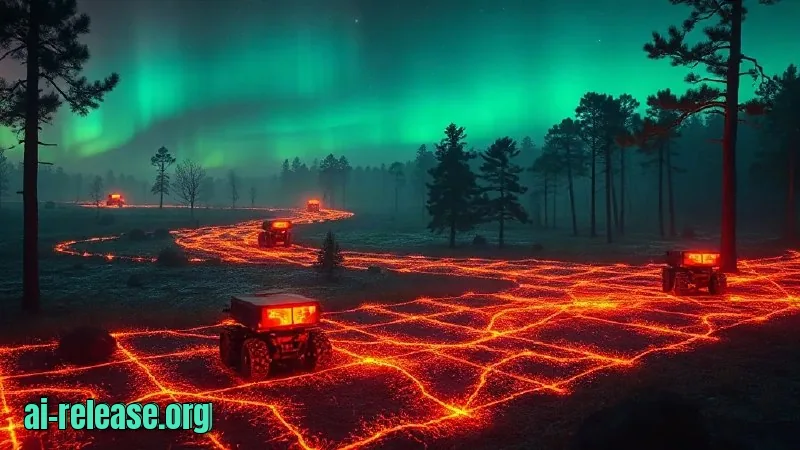
- DARPA put four autonomous ground vehicles (UGVs) through their paces in a RACER program exercise at Fort Knox, Kentucky.
- The robots built maps on the fly using onboard sensors only — no GPS.
- A human operator assigned tasks, verified findings, and decided whether to strike: the simulated missile launch was his call.
🔍 What happened
The program is called Robotic Autonomy in Complex Environments with Resiliency — RACER for short. Last month, DARPA took four autonomous UGVs to the Fort Knox proving ground and tested how they hunted for targets as a group and individually. Business Insider reported the story, citing DARPA technical advisor Jason Gregory. His framing: "we're pushing sensors and effectors forward, to the tactical edge, while keeping the operator safe," with the human retaining "control, responsibility, and situational awareness at all times."
Here's how it worked. The operator sat out of range and handed out tasks based on satellite imagery. The robots drove off on their own, building a map of their surroundings along the way — no GPS required. One vehicle spotted a potential target, a closed crate with a drone inside, and simply stopped. Then it was the human's call: he ordered the simulated missile launch. The software was tested on two types of chassis — a four-wheeled all-terrain vehicle and a tracked platform — so it wouldn't be tied to a single hardware platform. Behind RACER are five years of research into autonomy, AI algorithms, and off-road mobility, plus lessons from watching how ground robots are being used in the war in Ukraine.
🧠 Our take
The GPS-free operation is the most interesting part of this story. Jamming satellite navigation is cheaper than knocking out sensors, and the Pentagon says it outright: future fights will happen where GPS doesn't exist. A vehicle that can build its own map from lidar and cameras is worth far more in that scenario than one that can only follow coordinates. Our read: this isn't about "killer robots" — it's about resilient comms and navigation, the boring engineering foundation without which autonomy falls apart the moment it hits a jammer.
What does it mean for people and their wallets? Nothing directly, for now — these are military trials, not a product. But the tech leaks out: the same "onboard sensors + mapping on the move" combo is already at work in warehouse robots and delivery drones, and RACER's lessons will surface in civilian hardware within a few years. One more thing: DARPA is emphasizing the human's role in the loop. We think that's not just about ethics — it's legal cover too. Responsibility for a launch should stay with a specific person.
Who wins? The companies building sensor stacks and autonomous navigation software — their market is bigger than one army. Who loses? I wouldn't jump to conclusions. A trial with four vehicles tells you nothing about scaling, and the press release is honest about the field conditions — sand, swamps, forests, snow, and heat — that drain batteries and break comms.
⚠️ What we don't know
Not a single number: range, endurance, speed, distance from the operator, how long the scenario lasted. It's unclear how autonomous the movement decisions were versus the target classification. The phrase "the robots could work together" doesn't describe the coordination protocol. The source is a single one — a retelling of a DARPA representative's comments — and that's not independent verification. Take on faith only the fact that the exercise happened.
💬 Worth debating
- Is a human in the loop a guarantee of accountability, or a convenient fig leaf if the operator rubber-stamps everything in seconds?
- Should target detection be delegated to autonomous machines at all, or should the task stay with a human from start to finish?
- Is GPS-free operation preparation for fighting through jammers — or a signal that the military has already written off its satellites?
Forecast: within a year, DARPA will report porting the RACER software to new platforms; if no public data appears, I'd take that as a sign the program has gone dark.
Source: Business Insider
🤖 AI summary
- Date: 2026-11-14
- Source: www.businessinsider.com
- Tags: DARPA, RACER, автономные, GPS, роботы, автономность, AI, военныетехнологии
- Key facts:
- DARPA put four autonomous ground vehicles ( UGVs ) through their paces in a RACER program exercise at Fort Knox, Kentucky.
- The robots built maps on the fly using onboard sensors only — no GPS.
- A human operator assigned tasks, verified findings, and decided whether to strike: the simulated missile launch was his call.
- The program is called Robotic Autonomy in Complex Environments with Resiliency — RACER for short.
- Last month, DARPA took four autonomous UGVs to the Fort Knox proving ground and tested how they hunted for targets as a group and individually.
- Business Insider reported the story, citing DARPA technical advisor Jason Gregory.
- His framing: "we're pushing sensors and effectors forward, to the tactical edge, while keeping the operator safe," with the human retaining "control, responsibility, and situational awareness at all times." Here's how it worked.
- The operator sat out of range and handed out tasks based on satellite imagery.
Source: www.businessinsider.com · post in Telegram