Anthropic targets a $1.4 trillion valuation in its IPO THIS MATERIAL (INFORMATION) WAS PRODUCED AND DISTRIBUTED BY A FOREIGN
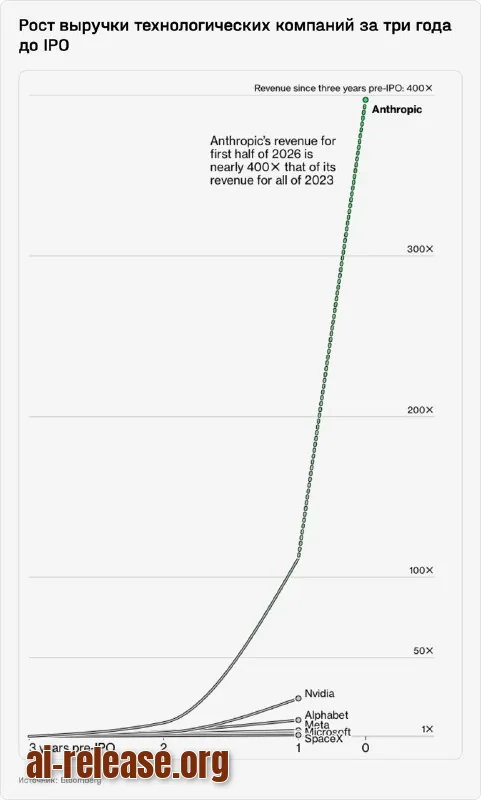
Anthropic targets a $1.4 trillion valuation in its IPO THIS MATERIAL (INFORMATION) WAS PRODUCED AND DISTRIBUTED BY A FOREIGN AGENT THE BELL OR CONCERNS THE ACTIVITIES OF FOREIGN AGENT THE BELL. 18+ Anthropic and its shareholders expect to sell up to $90.4 billion worth of shares, according to an SEC filing. They are offering shares at $70–78 each, with the final price to be set on November 18. At the top of the range, Anthropic's market capitalization would be about $1 trillion. The $1.4 trillion valuation accounts for potential dilution, including employee options and shares reserved for the company's charitable program. How the offering is structured ◾️ IPO — up to $64.4 billion. Anthropic will offer investors 801.4 million new shares, while existing shareholders will sell another 23.6 million. ◾️ Private placement — another $26 billion. The shares will be purchased by AMD, Broadcom, Google, Micron, Microsoft, Nvidia, and TSMC. This is a separate deal with major investors, to be completed immediately after the IPO. ◾️ The total could approach $100 billion if the IPO organizers exercise their right to sell additional shares, Bloomberg calculated. For comparison: SpaceX raised $86.2 billion in its IPO, including such an option. What else? Yesterday, Anthropic also unveiled updated AI models, Claude Fable 5.2 and Mythos 5.2. According to the company, they run up to 30% faster than the previous versions and cost less. Fable 5.2 handles complex programming and engineering tasks better: in one experiment, the model coordinated more than 1,000 AI agents while building an operating system, and in other tests it controlled robots. Mythos 5.2 is based on the same model but has fewer restrictions for cybersecurity and biological research tasks. Access to it will be granted only to organizations vetted by Anthropic. Why it matters Anthropic is aiming to become the first IPO of a company whose core business is developing cutting-edge AI models. It will have to convince investors that revenue from this activity can significantly exceed the growing infrastructure costs, which, together with commitments for future spending, have already reached a staggering $895 billion. Another risk is the unusual governance structure. The company is registered as a public benefit corporation and is required to consider not only shareholder interests but also AI safety issues. Moreover, a special trust (the Long-Term Benefit Trust) appoints and can remove the majority of board members, while the company's co-founders will control 50.1% of the votes on all other decisions. This significantly limits the influence of ordinary shareholders over the company's management. Rival OpenAI is still targeting an IPO in 2027. Its CEO Sam Altman called 2026 an unsuitable time to go public due to concerns about AI safety. Instead of going public, OpenAI raised about $11 billion in private funding at a $1.25 trillion valuation and expects to increase the round to $20 billion, Bloomberg reports. #analytics@thebell_invest 📍 Subscribe to the Bell.Investments channel
🤖 AI summary
- Date: 2026-11-11
- Source: t.me
- Key facts:
- Anthropic targets a $1.4 trillion valuation in its IPO THIS MATERIAL (INFORMATION) WAS PRODUCED AND DISTRIBUTED BY A FOREIGN AGENT THE BELL OR CONCERNS THE ACTIVITIES OF FOREIGN AGENT THE BELL.
- 18+ Anthropic and its shareholders expect to sell up to $90.4 billion worth of shares, according to an SEC filing.
- They are offering shares at $70–78 each, with the final price to be set on November 18.
- At the top of the range, Anthropic's market capitalization would be about $1 trillion.
- The $1.4 trillion valuation accounts for potential dilution, including employee options and shares reserved for the company's charitable program.
- How the offering is structured ◾️ IPO — up to $64.4 billion.
- Anthropic will offer investors 801.4 million new shares, while existing shareholders will sell another 23.6 million.
- ◾️ Private placement — another $26 billion.
Source: t.me · post in Telegram